
To search dating sites by email, run the address through a reverse email lookup tool that checks it against public records, data breach databases, and online account signals simultaneously. Enter the email into a platform like Searqle, and it returns any linked dating profiles, social media accounts, and identity records attached to that address — across platforms, in one report, within minutes. No individual dating app offers an email-based search from the outside, so this is the method that actually works.
Email addresses are among the most reliable anchors for tracing hidden dating profiles. Most dating platforms require a valid email at registration, and people frequently use the same address — or a predictable variation of it — across multiple accounts. A reverse email lookup exploits that consistency, tracing the address through its full online footprint rather than checking one platform at a time. This guide covers how that works, what it returns, and where the method has limits.
Why an Email Address Reveals More Than You Expect
An email address is not just a login credential. It is a persistent identity anchor that gets attached to account registrations, newsletter signups, data breach records, and public profile information over months and years. Every service a person signs up for using that address creates another data point connecting the email to an identity.
Dating apps are part of that pattern. Tinder, Bumble, Hinge, OkCupid, Match, Plenty of Fish, and most other platforms require an email address during account creation, even when registration is presented as phone-first. That email ends up in the service’s records, and when those records intersect with breach databases or public account signals, the connection becomes traceable.
A secondary email created specifically for private app registrations tells a similar story. The address itself may be unfamiliar, but the accounts registered with it form a coherent cluster that a reverse email search can surface. The email does not need to be publicly listed anywhere — it only needs to have been used.
How a Reverse Email Lookup Works
A reverse email lookup takes an address and queries it against multiple public data sources simultaneously: account registration records, social profile indexes, data breach databases, and public online presence signals. Where those sources have a record connecting that email to a name, a profile, or a linked account, the lookup returns the match.
Doing this manually — checking Google, then individual social platforms, then breach notification sites, then trying each dating app’s password recovery flow to confirm whether an account exists — takes an hour and still misses most sources. Searqle runs the same check automatically: enter the email address, and the platform scans public records and online account signals for every linked identity and profile attached to it. The result is a consolidated report covering the person’s name, associated social profiles, linked dating accounts where publicly traceable, address records, and any breach data connecting the email to specific services.
That consolidation is what makes the method practical. The email you enter does the work of narrowing the search to one specific person across an otherwise vast public web.
What a Reverse Email Report Can Return
| Data Type | Examples |
| Identity records | Full name, age range, known aliases, profile photos |
| Dating and social profiles | Linked accounts where the email connects to a public presence |
| Breach exposure | Services the email was registered with, surfaced from known data breaches |
| Contact connections | Linked phone numbers, secondary email addresses |
| Location records | Current and previous addresses, city and state history |
Breach data is one of the most useful sources for dating profile detection specifically. When a dating platform has had a confirmed data breach, the email addresses registered with it appear in breach databases. Running a known email against those records can confirm which dating services it was registered with, independent of whether any public profile is currently visible.
How to Search Dating Sites by Email With Searqle: Step-by-Step Guide
The full search takes under five minutes. Here is the process from start to result using Searqle:
- Open Searqle and select the email search option.
- Enter the full email address you want to investigate — including domain extension.
- Start the search and let the platform scan public records, account signals, and breach databases.
- Review the report for linked dating profiles, social accounts, name records, and breach data showing which services the email has been used with.
- If the report returns a name or linked phone number, run those as follow-up searches to build a more complete picture of connected accounts.
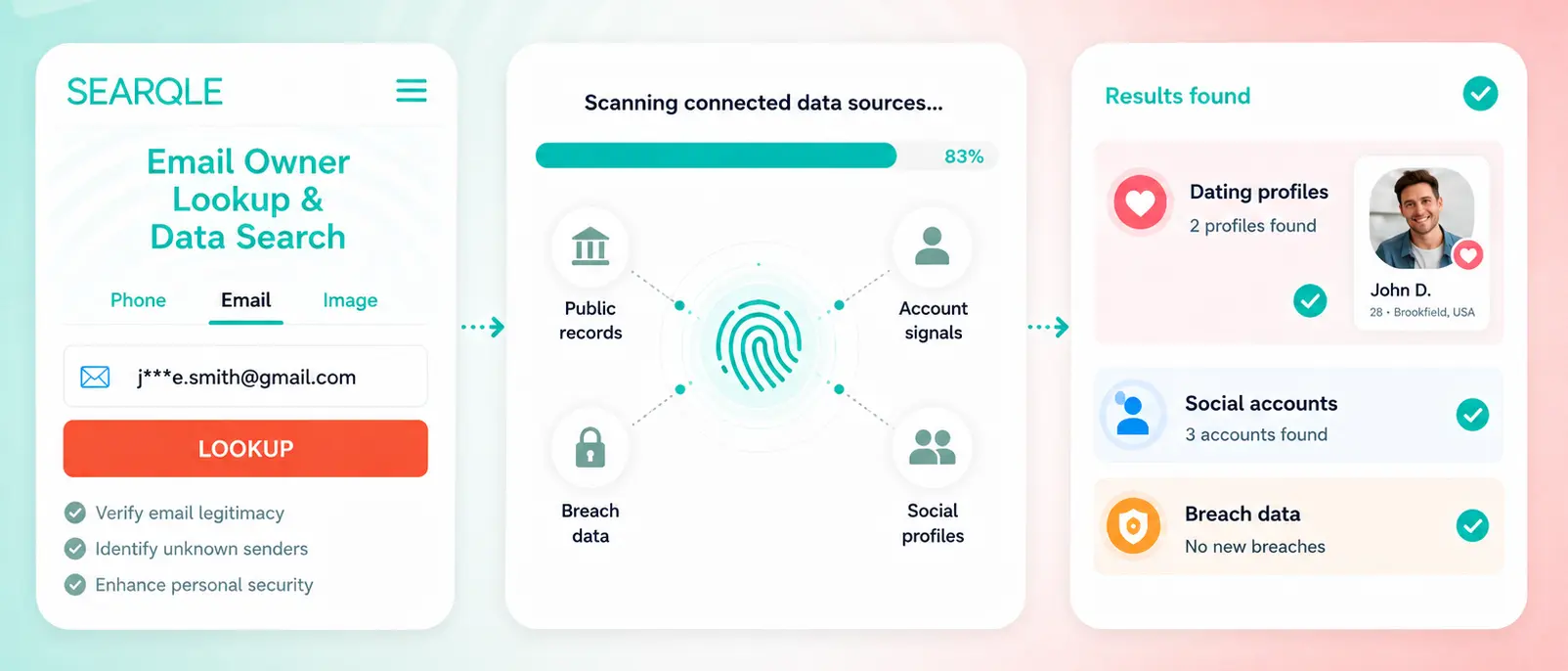
The mechanism: Searqle compares the email against publicly available records and indexed account data, consolidates any matches, and returns them in a single readable report. You are not checking each dating app individually or manually querying breach notification sites — one search covers the connected digital footprint of that address.
Searching a Secondary or Unknown Email Address
Some people create a separate email account specifically for dating app registrations, using a name or string that differs from their primary address. If you come across an unfamiliar email on a shared device, in a synced password manager, in an auto-fill suggestion, or in an SMS verification code, running it directly is often more revealing than searching the primary address.
A secondary email used only for hidden accounts tends to have a narrower but more focused footprint: fewer social registrations, but a clear cluster of accounts in categories the person wanted kept private. That clustering is exactly what makes the search informative.
When searching an unfamiliar address, pay attention to:
- The username portion of the address. A handle like a nickname, a birthdate, or a location string can confirm whether the address belongs to the person you are checking.
- Breach records. An email appearing in a breach from a dating platform is direct evidence it was registered there, even if no current public profile is visible.
- Linked phone numbers in the report. A secondary email often connects back to the same phone number used for primary accounts, which confirms ownership.
Where Email Search Has Limits
A reverse email lookup is the strongest method for tracing dating profiles by contact information, but it does not guarantee a complete result. Several factors can reduce what the search returns:
- Temporary or disposable email addresses: some people use throwaway email services for app registrations. These addresses have minimal footprints and rarely connect to identity records or breach data.
- Private account settings: a dating profile registered with an email but set to fully private leaves no publicly indexed presence for the search to surface, even if the account is active.
- Platforms with no known breaches: if a dating service has never had a confirmed public data breach, its registered emails do not appear in breach databases. The account may exist but not be traceable through this method.
- Recently created accounts: new registrations may not yet have propagated into any indexed source, making them invisible to a lookup even days after creation.
A result that returns nothing does not confirm no dating profiles exist. It means no publicly traceable connection to that email was found at the time of the search. When email search is inconclusive, a reverse phone lookup or reverse image search can pick up the trail through a different entry point.
Combining Email Lookup With Other Methods
Email, phone number, and photo are the three most reliable starting points for tracing a hidden dating profile. Each covers ground the others can miss, which is why using them in combination returns the most complete picture.
| Starting Point | Strongest At Finding | Falls Short When |
| Email address | Breach-linked accounts, identity records, service registrations | Throwaway emails, private profiles, unbreached platforms |
| Phone number | App-verified profiles, cross-platform identity connections | Numbers not reused across accounts |
| Profile photo | Stolen or reused images, cross-platform appearance | Original photos, recently posted, AI-generated images |
Searqle accepts all three inputs. Starting with an email, finding a linked name or phone number in the report, then running that number as a second search is a compound approach that covers both the contact trail and the account trail. Most hidden profiles leave evidence through at least one of these three entry points, even when they avoid leaving traces through the others.
Comparing Email Lookup Tools for Dating Profile Search
Several tools offer email-based profile searches. They differ in how many sources they check and how much identity context they return alongside a profile link. The table below compares Searqle against the most commonly used alternatives.
| Feature | Searqle | SocialCatfish | FootprintIQ | UserSearch |
| Email address lookup | Yes | Yes | Yes | Yes |
| Phone number lookup | Yes | Yes | Limited | No |
| Photo / image lookup | Yes | Yes | No | No |
| Identity & address records | Yes | Yes | No | No |
| Data breach exposure | Yes | Limited | No | No |
| Covers multiple platforms at once | Yes | Yes | Limited | Yes |
| Single consolidated report | Yes | Yes | No | No |
FootprintIQ and UserSearch focus on username-based searches across dating platforms and return profile links without identity context. SocialCatfish and Searqle both run multi-source searches and return consolidated reports. Searqle’s advantage in this use case is its breach exposure data alongside identity records: where FootprintIQ and UserSearch confirm whether a visible profile exists, Searqle can surface evidence of account registration even when no public profile is currently visible. It is the best fit for anyone starting with an email address who needs to know not just where a profile appears publicly, but which services that address has been used to register with.
Legal Context and Appropriate Use
Running a reverse email lookup using publicly available data and breach records is legal in most regions. The information returned comes from public sources and databases of previously exposed data — not from accessing private accounts or intercepting communications.
Common legitimate reasons to search dating sites by email include:
- Verifying the identity of someone you met online before sharing personal information or agreeing to meet.
- Checking whether a partner’s email address is connected to dating accounts or online activity they have not disclosed.
- Confirming that an email address you found unexpectedly on a shared device belongs to who you think it does.
- Identifying whether a contact who reached out to you has a verifiable online presence.
These searches return factual information about a digital footprint. How that information factors into any decision or conversation is a matter of personal judgment, and for significant relationship situations, speaking with a counsellor or trusted person alongside reviewing any search results is worth considering.
An Email Address Is Enough to Start
Searching dating sites by email requires no access to anyone’s account and no technical skill. An email address is enough. A reverse email lookup matches it against the full network of public records, breach databases, and account signals connected to that address, and returns the result as a single report.
If you have an email and need to know what dating profiles or online accounts are linked to it, running it through Searqle replaces hours of manual platform-by-platform checking with one search. Whether the address belongs to someone you are vetting, someone you trust, or someone who has been in contact with you unexpectedly, the report gives you an accurate picture of the digital footprint attached to it.