Tinder processes roughly two billion swipes a day. For a scammer, that’s two billion chances to find someone lonely, trusting, or simply in a hurry to fall in love. Tinder scams have existed since the app launched, but 2026 has changed the game: AI-generated faces, gamed verification badges, and fake crypto exchanges have made fraudulent profiles harder to spot than ever. A recent industry report on artificial intimacy found that 34% of current daters have been targeted by a dating scam, and nearly two-thirds of that group actually lost something — money, data, or both.
This guide breaks down the scams actually working right now, the red flags that give them away, and the verification steps that catch a fake match before it costs you anything.
Why Tinder Scams Are Harder to Catch in 2026
For years, the standard advice was simple: run a reverse image search on your match’s photos. If the picture showed up on a stock site or another person’s Instagram, you had your answer. That advice still matters, but it’s no longer enough on its own.
AI image generators now produce faces that have never existed anywhere online, which means a reverse image search on an AI-generated photo comes back clean — there’s nothing to find, because the “person” was never real to begin with. At the same time, Tinder’s own verification badge has proven easier to game than most users assume. A 2026 investigation cited by ConsumerAffairs showed that scammers can earn a verified blue check using stolen or digitally altered photos, because facial verification only confirms that a face appeared on camera at one moment — it says nothing about whether the identity behind the account has any real, consistent history.
That gap between “verified” and “trustworthy” is exactly where modern Tinder scams live. The badge tells you a photo matched a face. It doesn’t tell you whether the name, job, location, and backstory attached to that face actually add up.
The 7 Most Common Tinder Scams Right Now
Catfishing & Romance Scams
A scammer builds a fake identity — name, photos, backstory — and invests weeks in a believable relationship before making an ask. Catfishing on Tinder rarely starts with a money request; it starts with attention, compliments, and a fast-moving emotional connection designed to lower your guard before the real pitch arrives.
Red flag: the relationship feels unusually intense for how little time you’ve actually spent together. How to avoid it: slow the pace deliberately, and verify the person’s photos and identity before the relationship gets emotionally expensive to walk away from. This is the point where a quick lookup on a service like Searqle earns its place — running the match’s phone number or photo through a people-search report can surface a mismatched name, an address history that contradicts their story, or zero digital footprint at all, in under a minute, well before you’ve invested weeks in someone who doesn’t exist.
Pig Butchering / Crypto Investment Scams
Named for the practice of “fattening” a victim before the slaughter, pig butchering is the most financially devastating Tinder scam active today. The scammer builds trust for weeks, then casually mentions a cryptocurrency win. They offer to walk you through it on a platform they secretly control. Early “withdrawals” work perfectly — right up until you try to pull out a meaningful amount, at which point you’re told you owe fees, taxes, or a “verification cost” first. Average losses from this scam now exceed $100,000 per victim, and some people have lost far more.
How to avoid it: never invest through a platform your match recommends, and treat any dating-app introduction to crypto as an automatic red flag, no exceptions.
Verification Code / Phishing Scams
A match asks you to “verify” your identity by sharing a code texted to your phone, or by clicking a link that looks like a Tinder notification. In reality, the code hands them access to your real Tinder account, and the link harvests your login credentials or personal data. Tinder’s real verification process happens entirely inside the app — it never asks you to forward a code or click an outside link.
How to avoid it: never share a verification code with anyone, and never click a link claiming to be from Tinder that arrived by text or email.
Bot Profiles
Bots are automated accounts, not manually operated fakes, and it shows in how they talk. Replies feel generic, oddly enthusiastic, or slightly off-topic. A useful test: ask something a bot can’t script around, like “how many dogs could fit in a backpack?” A real person engages with the absurdity; a bot deflects or repeats itself.
How to avoid it: if two or three responses in a row feel scripted or mismatched to what you actually said, assume bot and move on.
The Overseas / Military Excuse Scam
Your match claims to be stationed abroad, working an offshore job, or otherwise unable to meet — always with a plausible-sounding reason. Weeks into the relationship, they need money to “come home,” cover a customs fee, or handle a sudden legal issue overseas.
How to avoid it: insist on a live video call early. Scammers running this script consistently avoid video, because their claimed circumstances rarely survive one.
The Sudden Emergency Ask
After a short but warm exchange, your match hits an emergency: a stolen wallet, a medical bill, a stranded situation that only cash, a gift card, or a wire transfer can fix. The request is designed to exploit empathy in the moment, before you’ve had time to think it through.
How to avoid it: never send money to someone you haven’t met in person, regardless of how real the emergency sounds or how strong the emotional pull is.
Blackmail & Intimate Photo Extortion
Once a scammer has an intimate photo or video, they threaten to share it with your contacts or post it publicly unless you pay. This scam depends entirely on shame and urgency to keep you from reporting it.
How to avoid it: never send images you wouldn’t want to see outside that conversation, and if you’re already being threatened, report it to Tinder and law enforcement immediately rather than paying — payment rarely ends the demands.
How to Verify a Match Before You Trust Them
Spotting the tactics above helps, but the fastest way to shut down a Tinder scam is to verify who you’re actually talking to before the relationship gets far enough to hurt.
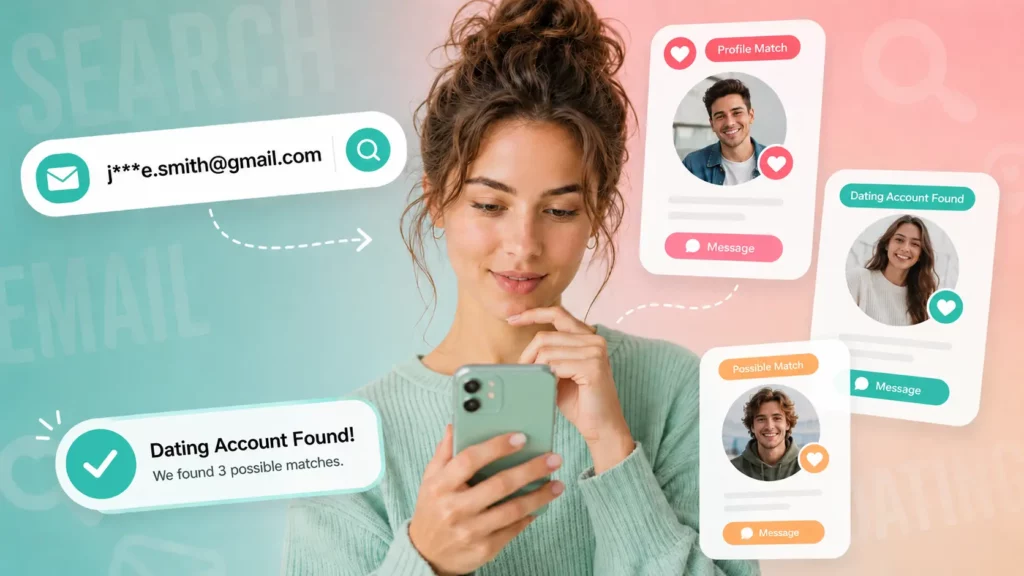
Searqle exists for exactly this moment. It’s a people-search platform that takes a phone number, email address, or photo and pulls together publicly available information into one readable report — names, known addresses, social profiles, and more — so you can check whether the person on the other end of the conversation matches the story they’re telling.
How it works: you submit the piece of information you already have — the phone number they texted from, the email on a “business” link they sent, or a screenshot of their profile photo — and Searqle scans public and online records to compile a report on that identity.
How to start:
- Copy the phone number, email, or a clear profile photo from your match’s Tinder conversation.
- Enter it into Searqle’s search bar and run the lookup.
- Review the report for a name match, address history, and any social profiles tied to that contact info or photo.
- Compare what you find against what your match has told you — inconsistencies are your answer.
Run this check before the conversation moves past small talk, and definitely before any request for money, gift cards, or crypto comes up. It takes less time than a coffee order.
12 Red Flags That Signal a Tinder Scammer
- They push to leave Tinder for text, WhatsApp, or email within the first few messages.
- Their photos look studio-quality, overly polished, or slightly “off” in a way you can’t quite name.
- They avoid specific questions about their job, hometown, or daily life with vague answers.
- They profess strong feelings unusually fast, before you’ve had more than a few real conversations.
- They always have an excuse for why a video call isn’t possible.
- They mention cryptocurrency, an “investment opportunity,” or a trading platform.
- They ask you to click a link to “verify” your Tinder account.
- They request a code that was texted to your phone.
- They claim to be overseas, deployed, or working offshore and unable to meet.
- They introduce a financial emergency that only cash, gift cards, or a wire transfer can solve.
- They get irritated or defensive when you set a boundary or ask a direct question.
- Their digital footprint doesn’t add up — no consistent history across the accounts, name, or location they’ve claimed.
If you’re seeing two or more of these at once, pause the conversation and verify before you go any further.
Searqle vs. Other Verification Methods
| Feature / Criteria | Searqle | Google/TinEye Reverse Image Search | Generic Background-Check Sites |
| Works when there’s no photo, only a phone or email | Yes | No | Partial |
| Detects AI-generated faces (no image match exists) | Yes — cross-references contact data, not just the image | No | Limited |
| Single report combining name, address, and social profiles | Yes | No | Yes |
| Results in under a minute | Yes | Yes | No — often multi-day |
| Built specifically for dating/identity checks | Yes | No | No |
Reverse image search is still worth doing — it’s free and it catches the laziest catfishing attempts. But it only works if the photo exists somewhere else online, and AI-generated faces have no “somewhere else” to be found. Searqle is built for the cases image search can’t touch: verifying the phone number that texted you, the email behind a “portfolio link,” or confirming that a name, face, and address history are actually consistent with each other. For anyone doing more than a handful of first dates a year, that combination matters more than a single image match.
What to Do If You’ve Been Scammed on Tinder
If you’ve already sent money, shared personal information, or suspect your account has been compromised, act quickly:
- Stop all contact with the scammer immediately — don’t try to negotiate or ask for the money back.
- Screenshot everything — messages, profile, payment confirmations — before you block them.
- Report and block the profile inside Tinder so the platform can act on it.
- File a report with the FBI’s Internet Crime Complaint Center at ic3.gov, which tracks romance and dating fraud nationally.
- If financial information was shared, freeze your credit, review your credit report for new accounts, and contact your bank to flag any unauthorized transactions.
- Replace compromised cards and change reused passwords tied to the exposed information.
Feeling embarrassed afterward is common, but it’s misplaced — these scams are built by people who do this professionally, often running dozens of conversations at once. The fact that one was convincing says more about the scammer’s practice than about your judgment.
Final Thoughts: Trust, But Verify
Tinder scams in 2026 aren’t cruder than they used to be — they’re better funded, better scripted, and harder to spot with the naked eye alone. The good news is that verification has kept pace. A quick Searqle lookup on a phone number, email, or photo takes less time than typing out a reply, and it turns “this feels a little off” into a clear answer before you’ve handed over anything that matters. Slow down, ask the questions that scammers can’t script around, and check before you trust.
More Helpful Articles
How to Catch a Cheater Online — If a partner’s digital habits don’t match their story, this guide walks through the platforms, patterns, and public records worth checking before you confront them.
Reverse Image Search for Catfishing — A closer look at how reverse image search works, where it falls short against AI-generated photos, and how to combine it with other verification tools for a fuller picture.
Tinder Profile Search — A step-by-step walkthrough of looking up a Tinder match by name, username, or photo before your first real conversation goes any further.