Romance scams cost Americans hundreds of millions of dollars every year, and the number keeps climbing as scammers get better at building convincing fake identities. The FTC has reported tens of thousands of victims annually, with many losses running into the thousands of dollars per person. Online dating scams don’t usually start with an obvious red flag — they start with a flattering message, a fast connection, and a story that feels real enough to lower your guard.
This guide breaks down the warning signs that separate a genuine match from a scam, explains how these schemes actually work, and walks through a simple way to verify who you’re talking to before you send a single dollar or share personal details.
What Are Online Dating Scams?
An online dating scam, often called a romance scam, happens when someone creates a fake identity on a dating app, social platform, or messaging service specifically to manipulate a victim emotionally and financially. The scammer isn’t looking for a relationship — they’re building one on purpose, because trust is the tool they use to ask for money later.
These scams follow a predictable arc. First contact is warm and attentive. Conversations move quickly from casual to intense. Within days or weeks, the scammer introduces a reason they can’t meet in person — work overseas, military deployment, a family emergency — and starts laying the groundwork for a financial request. By the time money changes hands, the victim has often invested weeks of daily conversation and genuine emotional attachment.
Why These Scams Are Harder to Catch Than Ever
A few years ago, spotting a scam profile was fairly simple: blurry photos, broken English, and an obviously fake bio. That’s changed. Scammers now pull high-resolution photos from real people’s social media accounts, write in fluent, natural-sounding language, and maintain consistent personas across multiple platforms.
Some scammers use AI tools to generate profile photos that don’t belong to any real person, which makes a basic reverse image search less reliable than it used to be. Others recycle stolen photos from military personnel, aid workers, or engineers — professions that conveniently explain why someone is “unavailable” to video call or meet up. The result is a profile that looks and sounds like a real, busy, credible person, right up until the money request arrives.
9 Warning Signs of an Online Dating Scam
Most romance scams share a handful of common patterns. Watching for these signs early can save weeks of emotional investment and real financial loss.
- The relationship moves unusually fast. Declarations of love or deep affection within days of first contact are a classic pressure tactic, not a sign of genuine connection.
- They avoid video calls and in-person meetings. Every excuse — a broken camera, a bad connection, a work restriction — is designed to keep their real appearance and identity hidden.
- Their profile photos look professionally shot. Model-quality images, especially ones that appear across unrelated profiles, are a strong sign the pictures were taken from someone else’s account.
- Their story has small inconsistencies. Ages, job details, or hometowns that shift slightly between conversations usually mean the scammer is managing more than one script at once.
- They push the conversation off the dating app quickly. Moving to WhatsApp, email, or text removes the platform’s built-in reporting and safety tools.
- They claim to work somewhere isolating. Oil rigs, overseas military postings, and international aid work are recurring cover stories because they explain away video calls, in-person meetings, and slow replies.
- They ask personal or financial questions early. Requests for your address, workplace, or financial details before you’ve even met in person are a sign the relationship is a means, not an end.
- They eventually ask for money. Whether it’s a medical bill, a plane ticket, or a cryptocurrency “opportunity,” a request for money from someone you haven’t met in person is the single clearest sign of a scam.
- Friends or family raise concerns you’ve been dismissing. Scammers often work to isolate victims from outside opinions — if people close to you are worried, take that seriously.
This is also the point where a lot of people find themselves stuck: the person seems genuine, but something feels off, and there’s no easy way to check. That’s the gap Searqle is built to close — instead of guessing, you can run a phone number, email address, or photo through a report that surfaces public records tied to that identity, so you’re deciding based on information instead of instinct alone.
How Scammers Ask for Money — and Why It Works
Money requests rarely arrive as a blunt demand. They’re usually wrapped in a story specifically chosen to bypass your skepticism: a medical emergency, a customs fee on a gift they’re sending, a visa problem preventing them from traveling to see you, or a “guaranteed” cryptocurrency investment they want to let you in on.
Scammers favor payment methods that are fast and difficult to reverse — wire transfers, gift cards, and cryptocurrency are the most common. Once a payment goes through, especially by gift card or crypto, it’s nearly impossible to recover. If a match you haven’t met in person asks for money through any of these channels, treat it as a scam regardless of how convincing the story sounds.
Verify Before You Trust: A Simple Way to Check Who You’re Talking To
Most safety advice stops at “trust your gut,” but a gut feeling isn’t always enough when someone has spent weeks building a convincing persona. Searqle gives you a concrete way to check the details instead of relying on instinct alone.
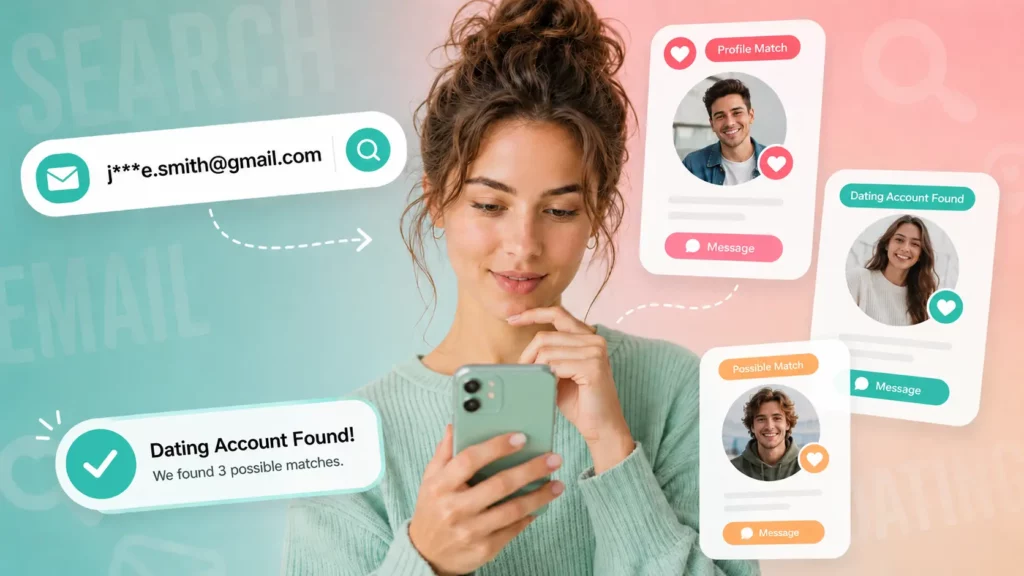
Here’s how it works: you enter a phone number, email address, or a photo into Searqle’s search tool, and the platform scans public and online sources connected to that identifier. Within minutes, it compiles a report that can include the name associated with that contact, known aliases, past addresses, social profiles, and — for photos — whether the same image appears attached to other names or profiles elsewhere online. That last part matters, because a photo tied to three different names across three different sites is a near-certain sign of a stolen image.
Getting a report takes a few steps:
- Go to Searqle and choose whether you’re searching by phone number, email address, or photo.
- Enter the information from the profile you want to check.
- Review the compiled report, which can include identity details, associated contact records, address history, and public social profiles.
- Compare what the report shows against what the person has told you — mismatches in name, location, or age are worth a direct conversation before you go any further.
If a reverse image search is your go-to check, you can dig deeper on that specific method in our guide to reverse image search for catfishing, which walks through how to search a photo across the web step by step.
Searqle vs. Other Safety Tools

Several identity and security tools mention romance scam protection as part of a broader product. Here’s how a dedicated search tool like Searqle compares on the checks that matter most before a first date.
| Feature / Criteria | Searqle | Aura | LifeLock (Norton) |
|---|---|---|---|
| Search by phone number | Yes | Limited | Limited |
| Search by email address | Yes | Limited | Limited |
| Search by photo | Yes | No | No |
| Pay-per-check trial option | Yes (7-day trial) | No — subscription only | No — subscription only |
| Report focus | Identity verification of a specific person | Ongoing personal credit/identity monitoring | Ongoing personal credit/identity monitoring |
| Best suited for | Checking a specific match before meeting | Monitoring your own identity and finances over time | Monitoring your own identity and finances over time |
Aura and LifeLock are built to protect your own identity and finances after the fact — think credit monitoring and dark web alerts tied to your personal information. Searqle solves a different problem: it lets you check someone else’s identity before you’ve handed over any trust or money. If your main goal is confirming that the person on the other end of a dating app conversation is who they claim to be, a direct phone, email, or photo search answers that question faster than a monitoring subscription built around your own accounts.
If You Think You’re Already Talking to a Scammer
If several of the warning signs above match what you’re seeing, don’t wait for more proof before acting.
- Stop sending money immediately, even if the story sounds urgent or the person threatens to disappear if you don’t help.
- Run a check on their contact details. A phone number search can surface whether the number is tied to a name that doesn’t match their profile, or to other dating profiles under a different identity.
- Stop replying and preserve the conversation. Screenshots of messages and payment requests are useful if you need to report the scam.
- Report it. File a complaint with the FTC at ReportFraud.ftc.gov or the FBI’s Internet Crime Complaint Center at ic3.gov, and report the profile to the dating app or platform where you met.
- Contact your bank or payment provider right away if you’ve already sent money — some transfers can be flagged or reversed if you act quickly.
- Talk to someone you trust. Scammers often work to isolate victims from outside opinions, and a second perspective can confirm what you’re already suspecting.
A Quick Safety Checklist Before Your Next Match
- Video call before making any emotional or financial commitment.
- Run a photo or contact search if anything about their profile feels inconsistent.
- Keep conversations on the dating platform until you’ve met in person.
- Never send money, gift cards, or cryptocurrency to someone you haven’t met face to face.
- Meet the first time in a public place and arrange your own transportation.
- Tell a friend who you’re meeting and where.
Staying Safe Starts With One Extra Step
None of this means treating every match with suspicion. Most people on dating apps are exactly who they say they are. The goal isn’t paranoia — it’s adding one verification step before the relationship moves past the point where a red flag is easy to walk away from.
When something about a match doesn’t sit right — a photo that looks too polished, a story that shifts slightly between conversations, a request to move off the app — a quick Searqle report gives you a factual answer in minutes instead of a lingering doubt. Start with a phone number, an email address, or a photo, and know who you’re actually talking to before the conversation goes any further.