You match with someone on Bumble, the conversation flows, and within a few days it feels like something real. Then something feels off — they dodge video calls, ask for money, or push you toward a link. Bumble scams follow a recognizable pattern, and once you know what to look for, most fake profiles and bots are easy to catch before they cost you anything.
How Common Are Fake Profiles and Bots on Bumble?
Fake profiles are not a rare edge case on dating apps. A 2025 study by Pour Moi found that 62% of people could not tell a real dating profile from an AI-generated one, which means gut instinct alone is no longer a reliable filter. Romance scams have also become a serious financial threat: reporting on the issue notes that Americans have lost over $1.3 billion to romance scams in recent years, and a large share of those losses trace back to matches whose identity was never checked.
Bumble has responded with its own defenses. The company’s AI-based moderation tool is designed to catch fraudulent accounts before they ever reach you, and Bumble reports that testing showed its Deception Detector supported blocking 95% of spam and scam accounts automatically. That still leaves a meaningful percentage of fake accounts getting through — and it does nothing to protect you once a conversation moves to text messages or WhatsApp, which is exactly where most scams escalate. This is where a quick, independent identity check earns its place in your routine. A tool like Searqle lets you run a match’s phone number, email, or photo through public records and online sources in one search, so you’re not relying solely on the badge next to their name.
The Most Common Types of Bumble Scams
Bumble scams tend to fall into a handful of repeatable categories. Knowing the shape of each one makes it much faster to recognize when you’re in the middle of one.
- Romance and long-distance scams. A match builds emotional intimacy quickly, often claiming to be stationed abroad, working on an oil rig, or traveling for work — then introduces a financial “emergency” once trust is established.
- Bot accounts that push outside links. Automated accounts carry on human-sounding conversation through Bumble’s messaging platform before redirecting you to a paid site or a phishing page disguised as something else.
- Sextortion. A match convinces you to share intimate photos or video, then threatens to leak the content unless you pay.
- Pig-butchering crypto scams. The conversation shifts toward an “investment opportunity,” usually a crypto platform the scammer controls, and you’re pressured to deposit increasingly large amounts.
- Phishing “verification” links. You’re sent to a fake login page styled like Google, iCloud, or Instagram and asked to “verify your age” — entering your credentials hands your password directly to the scammer.
Red Flags: How to Spot a Fake Profile on Bumble
Before a conversation ever turns toward money, most fake profiles show warning signs on the profile itself:
- Photos look staged, not candid. Model-quality shots with no casual selfies, no group photos, and no visible imperfections are a common tell.
- Little or no verification badge. Bumble’s Photo Verification checks that a live selfie matches the profile photos; a profile with no badge — or only the basic checkmark rather than the full ID-verified badge — deserves more scrutiny.
- A bio that’s vague or copy-paste generic. Real people mention specific details — a job, a neighborhood, a hobby. Scam profiles often stick to broad, interchangeable phrases.
- They avoid meeting or video calling. Repeated excuses about unreliable Wi-Fi, work travel, or sudden emergencies are a pattern, not a coincidence.
- The story doesn’t hold up under casual questions. Ask something specific and local, like a favorite spot in their stated city. Vague or contradictory answers are worth noting.
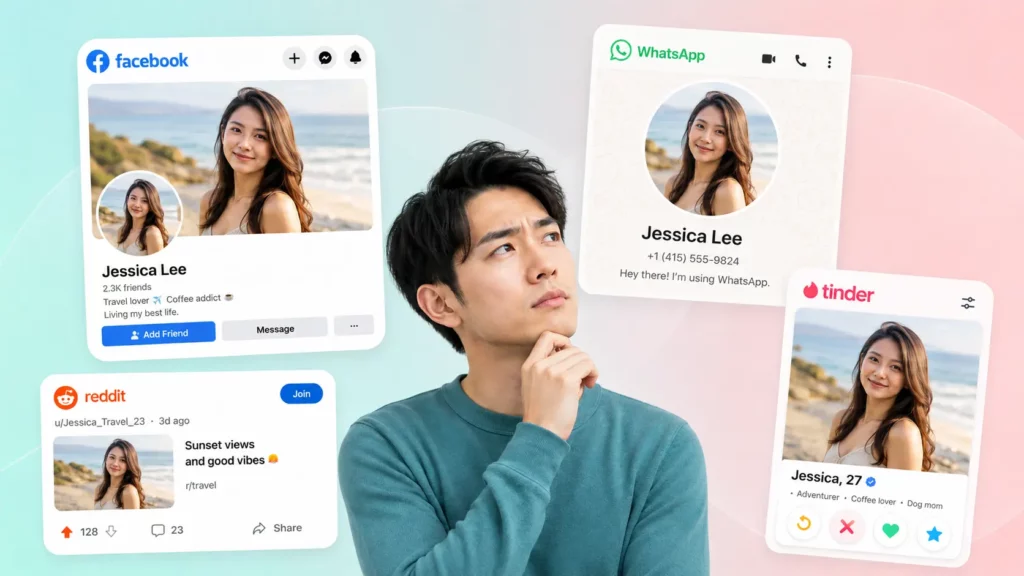
If two or more of these signs show up together, it’s worth pausing before you invest more time or trust. A fast way to confirm your suspicion is to reverse image search a profile photo — you can read our full walkthrough on how to run a reverse image search to catch a catfish for the exact steps.
How to Tell If You’re Talking to a Bot on Bumble
Bots and human scammers leave different fingerprints. Bots specifically tend to:
- Reply instantly, at any hour, with no natural delay. Real people pause to think, get distracted, or reply hours later.
- Steer every conversation toward a link. If a match brings up a website, webcam show, or “download this app” within the first few messages, that’s a bot behavior, not a coincidence.
- Give generic, slightly off responses. Answers that almost fit your message but miss specific details you mentioned are a sign you’re talking to an automated script.
- Never ask follow-up questions about you. A bot is optimized to deliver its script, not to build a two-way conversation.
- Refuse or ignore requests to video chat entirely, rather than making excuses — bots simply can’t do it.
If you notice two or more of these bot behaviors, blocking and reporting the account is the fastest way to shut it down.
How to Verify Who You’re Really Talking To
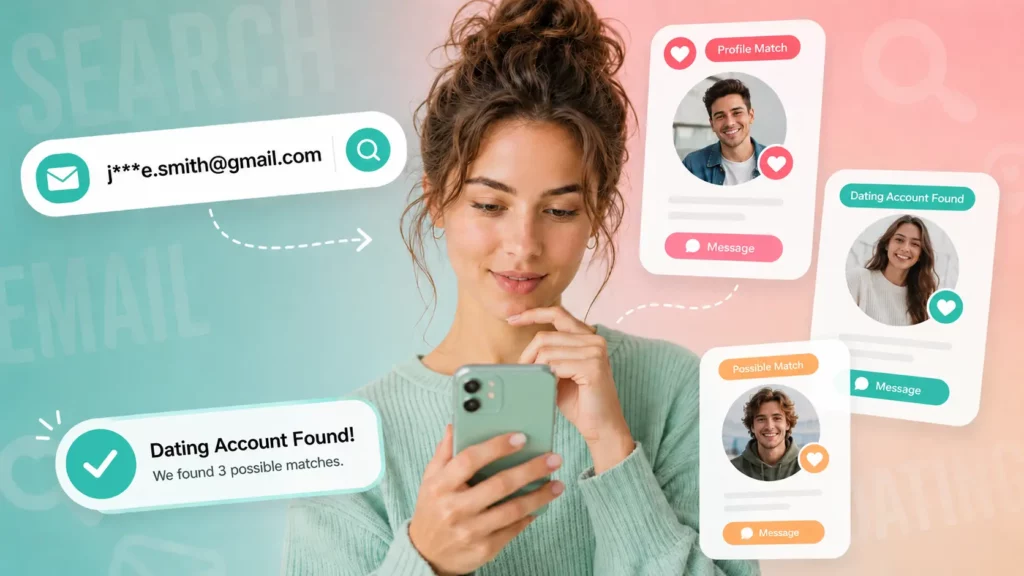
Reading red flags gets you most of the way there, but confirming an identity takes an actual lookup. This is the exact problem Searqle is built for: when a match’s story doesn’t quite add up but you don’t have hard proof either way, Searqle lets you search a phone number, email address, or photo and pull together publicly available information — social profiles, associated names, and location history — into one readable report. Instead of guessing, you get a concrete answer in minutes.
Getting started takes only a few steps:
- Grab one detail — the phone number they texted from, the email on their profile, or a saved copy of their photo.
- Run a search on Searqle using that phone number, email, or photo.
- Review the report for mismatched names, inconsistent locations, or a phone number type — like a VoIP line — that doesn’t match their story.
- Compare what you find against what they’ve told you, and decide whether to proceed, ask more questions, or block and report.
If the number they’ve been texting from turns out to be a VoIP line registered somewhere they never mentioned, that alone is enough to slow down. Our guide on how to find dating profiles by phone number walks through this specific check in more detail.
Searqle vs. Other Ways to Verify a Bumble Match

There’s more than one way to check a match, and each method has real limitations. Here’s how the common options compare:
| Feature / Criteria | Searqle | Social Catfish | Free Reverse Image Search |
|---|---|---|---|
| Phone number lookup | Yes | Yes | No |
| Email lookup | Yes | Yes | No |
| Photo / reverse image lookup | Yes | Yes | Partial (basic matches only) |
| One report combining name, phone, email, and photo | Yes | Yes | No |
| Data breach exposure check | Yes | Not standard | No |
| Entry-level trial cost | 7-day trial, €1.00 | 3-day trial, ~$5–6 | Free |
| Report speed | Fast, self-service | Can be slower for full reports | Instant, but shallow |
Free reverse image search tools like Google Images or TinEye are a reasonable first step, but they only check one data point — a photo — and often miss images that a scammer has slightly cropped or altered. Social Catfish covers similar ground to Searqle across phone, email, and photo lookups, but user reviews frequently point to a more complicated billing flow and slower turnaround on full reports.
Searqle fits best when you want a single, fast search across multiple data points — phone, email, or photo — without juggling separate tools for each one. It’s the right choice the moment a match asks to move off Bumble or a detail in their story stops adding up, and it’s built for anyone doing their own due diligence before investing more time, trust, or money in someone they haven’t met in person.
What to Do If You Think You’re Being Scammed on Bumble
If the signs are lining up, act before the situation escalates:
- Stop sending money or personal information immediately — a real match will understand a pause; a scammer will pressure you not to.
- Screenshot the conversation before you block them, in case you need it for a report later.
- Use Bumble’s Block & Report feature and select the reason that matches what happened — stolen photo, scam, or solicitation.
- Report the incident to the FTC or IC3 if money, images, or personal data changed hands.
- Tell a friend or family member what happened. A second opinion often catches details you’re too close to see.
If you’re also questioning whether the same pattern is showing up in an existing relationship rather than a new match, our guide on how to catch a cheater online covers how to confirm whether someone’s story checks out.
Staying Safe While Swiping on Bumble
Bumble’s verification badges and Deception Detector catch a large share of fake accounts, but no automated system catches everything, and none of them protect you once a chat moves to WhatsApp or Telegram. The habits that actually keep you safe are simple: watch for the early red flags, ask for a video call before you get emotionally invested, and don’t send money or intimate images to someone you haven’t met in person. When something still feels unresolved, running a quick check on Searqle takes a few minutes and gives you an actual answer instead of a guess — a small step that can save you far more than it costs.