You’ve started Googling their name. You’ve screenshotted the conversation to send to a friend. Something feels off, and you’re reading this because your gut is already telling you what your heart doesn’t want to hear.
That instinct is worth listening to. Nearly 55% of online daters in the U.S. say they’ve encountered a fake profile, and the tactics keep evolving. Below are the ten warning signs that actually hold up across real catfishing cases, plus how to confirm your suspicion instead of just sitting with it.
What Catfishing Actually Looks Like Today
Catfishing is when someone builds a fake identity online, usually with stolen photos and a fabricated backstory, to start a relationship under false pretenses. The motive varies: some catfishers want money, some want attention they can’t get as themselves, and some are running a long-term romance scam with a script.
What’s changed recently is the photo problem. AI image generators can now produce a face that doesn’t belong to any real person, which means a classic reverse image search sometimes comes back clean even when the profile is fake. That doesn’t make the old warning signs useless — it makes the behavioral ones more important than ever.
The 10 Warning Signs
1. They Refuse Video Calls or Always Have an Excuse
This is the single most reliable tell. A broken camera, bad internet, a work restriction, a sick relative — one excuse is normal life. A rotating cast of excuses over weeks or months means the person on the other end doesn’t look like their photos.
2. Their Photos Look Too Professional
Real people post a mix of content: a bad-lighting selfie, an awkward group shot, a photo a friend tagged without asking. Catfish profiles skew the other way — every image is well-lit, well-composed, and flattering, with no unflattering angles at all.
3. Their Social Media Is Thin or Brand-New
A profile with a handful of posts, almost no friends, and zero tagged photos usually means the account was built for one purpose. This is also the point where most people realize they need more than a gut feeling — they need to see where else that name, number, or photo shows up online. A tool like Searqle lets you run a quick phone, email, or photo lookup and pull together public records, social profiles, and prior activity in one report, instead of manually checking five different apps and hoping you didn’t miss something.
4. The Relationship Is Moving Unusually Fast
Declarations of love within days or weeks, constant compliments, and talk of a shared future before you’ve had a single video call — this pattern is called love bombing, and it’s designed to lower your guard before the eventual ask.
5. Their Story Doesn’t Add Up
They claim to work at a specific company but can’t answer basic questions about it. They say they went to a certain school but don’t know anything about the campus. Small inconsistencies compound because maintaining a fabricated identity across months of conversation is hard to do without slipping.
6. They Push You to Switch Apps Immediately
Catfishers often try to move the conversation off the dating app and onto WhatsApp, Telegram, or a similar platform almost right away. These apps have weaker built-in safety monitoring, which makes it harder for the platform — or for you — to flag suspicious behavior later.
7. They Ask for Money, Gifts, or Sensitive Info
This is the point where a catfish becomes a scam. Requests usually involve a manufactured crisis, a wire transfer or peer-to-peer app that’s difficult to reverse, or gradually escalating asks for personal details you wouldn’t normally share.
8. They Mirror Your Interests Too Perfectly
Loving the exact same bands, shows, and hobbies as you can feel like fate. It’s often a tell. Catfishers frequently research a target’s public profiles first, then reflect those interests back to manufacture instant compatibility.
9. They Avoid Meeting In Person
Same pattern as video calls, but higher stakes. If someone has had months to plan a meetup and it keeps falling through for reasons that don’t quite hold up, that avoidance is the message.
10. Reverse Image or Face Search Turns Up a Different Name
If a profile photo shows up attached to a different name, or the same “unique” pickup line has been sent to other people online, you’ve moved from suspicion to evidence. This is worth doing properly rather than a single quick Google search — here’s a full walkthrough of running a reverse image search if you want to confirm a photo before it goes any further.
How to Verify Who You’re Really Talking To
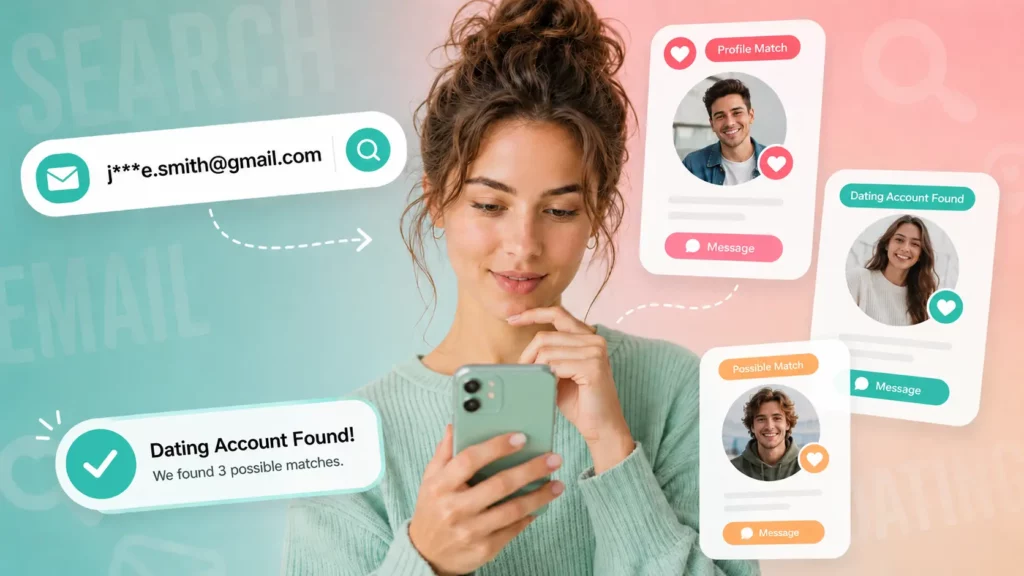
Spotting behavioral red flags gets you most of the way there, but confirming identity closes the gap between “I have a bad feeling” and “I know.” Searqle pulls together publicly available information tied to a phone number, email address, or photo into one report, so you’re not jumping between five different search tools and social platforms by hand.
Here’s how it works in practice:
- Take what you have — their phone number, email address, or a saved photo from their profile.
- Run it through Searqle’s search tool. The platform checks public and online sources and compiles what it finds into a single readable report.
- Review the report for mismatches: a different name attached to that number, a photo that surfaces under another profile, or address and background details that contradict what they’ve told you.
- Use what you find to decide your next step — whether that’s asking a direct question, or ending contact entirely.
A single search credit is usually enough to run one check. The trial gives you room to test it before deciding whether you need it again.
Searqle vs. Other Ways to Check a Profile
| Feature / Criteria | Searqle | Manual Reverse Image Search | TruthFinder | BeenVerified |
|---|---|---|---|---|
| Combines phone, email, and photo search | Yes | No — photo only | Partial | Partial |
| Single consolidated report | Yes | No | Yes | Yes |
| Catches stolen photos across platforms | Yes | Limited to indexed images | Yes | Yes |
| Trial available before subscribing | Yes (7 days, €1.00) | Free but manual | Limited | Limited |
| Setup time | Under 5 minutes, no account verification steps | Free but time-consuming | Account setup required | Account setup required |
If all you have is a suspicion and a photo, a manual reverse image search is a reasonable first move — it’s free, and it’s exactly what the section above walks you through. Where it falls short is scale: it only checks that one image, on the platforms that image search happens to index. Searqle is a better fit once you have a phone number or email in hand too, since it checks across multiple data points at once instead of just pixels, which matters more now that AI-generated profile photos can slip past a plain reverse image search entirely.
What to Do If You Confirm You’re Being Catfished
- Stop responding. You don’t owe an explanation or a chance to “make things right.”
- Don’t send money, gift cards, or crypto — including to “pay back” something you already sent.
- Block them across every platform where you’ve been in contact, not just the one where it started.
- Save screenshots of the conversation and any payment requests before you block, in case you need to report it.
- Report the profile to the platform and, if money changed hands, to the FTC or your local authorities.
- Tell a friend or family member. Outside perspective is one of the fastest ways to catch what you might be too invested to see.
Trust the Pattern, Not the Excuse
No single warning sign proves someone is catfishing you. A missed video call or a slow-to-fill-out profile happens to real people too. What matters is the cluster: avoidance of video and in-person meetings, a social presence that doesn’t hold up, a story that shifts under questioning, and a relationship that’s moving faster than the facts can support.
If two or three of these signs are stacking up, don’t wait for a bigger one to confirm it. Pull whatever you have — a number, an email, a saved photo — and run it through Searqle to see what actually surfaces before you invest anything more.
More Helpful Articles
- How to Catch a Cheater Online — If the red flags you’re noticing point less toward a stranger and more toward a partner hiding something, this guide breaks down the digital trail cheating usually leaves behind and how to check it.
- Reverse Image Search: Catching a Catfish — A step-by-step walkthrough for running a proper reverse image search on a profile photo, including what to do when the photo comes back clean but your gut still says something’s wrong.