Romance scams cost Americans more than a billion dollars a year, and the real number is almost certainly higher, because most victims never report what happened. If you’re dating online in 2026 — through an app, a game, or even a “wrong number” text that turns into a conversation — you’re a potential target, regardless of your age, income, or how careful you think you are. This guide breaks down how romance scams actually work, the specific warning signs to watch for, and the steps you can take right now to verify who you’re really talking to.
What Is a Romance Scam, Exactly?
A romance scam happens when someone builds a fake romantic relationship with you online, purely to get access to your money, your personal information, or both. The relationship itself is the tool. The scammer isn’t trying to seduce you for its own sake — they’re using affection and attention as leverage, the same way a con artist uses a fake investment pitch or a fake prize notification.
Most romance scams start the same way: a profile appears on a dating app, a social platform, or even in your text messages. The photos look normal. The bio is believable. Early conversation feels easy and flattering. That’s by design. Scammers run dozens of these conversations at once, and they keep whichever ones respond well.
Why Romance Scams Work: Love Bombing and Isolation
Romance scams succeed because they target emotional vulnerability, not technical ignorance. The tactic has a name: love bombing. It’s a pattern of excessive, fast-moving affection — daily messages, declarations of love within days or weeks, and a sense that you’ve finally found someone who “gets” you. That intensity isn’t romance. It’s a pressure technique that short-circuits the normal pace at which trust is supposed to build.
Once trust is established, isolation follows. The scammer often pushes the conversation off the dating app and onto text, WhatsApp, or email, where there’s no platform moderation and no paper trail the app can flag. They’ll ask about your recent breakup, your late spouse, your retirement savings, or your loneliness — details that later become the exact pressure points they use when the money conversation starts.
How to Verify Someone You Just Met Online
Here’s the problem: none of the advice above helps if you can’t actually check whether the person on the other end of the conversation is who they claim to be. A profile photo and a first name aren’t enough information to go on, and most people don’t know where to start looking.
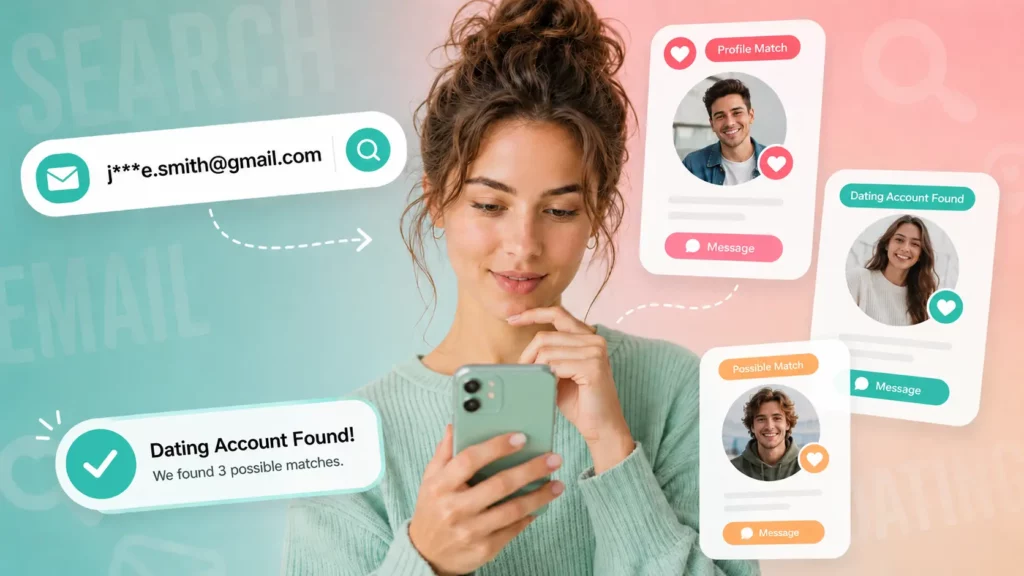
This is where a people search and identity verification platform like Searqle earns its place in your process. Instead of manually guessing whether a photo is stolen or a phone number is real, Searqle lets you run a phone number, email address, or photo through public records and online sources and get back an organized report — associated names, locations, and any social or public profiles tied to that identity.
How it works: you enter the phone number, email, or photo you have for the person, Searqle scans public and online sources for matching records, and it compiles the results — names, known aliases, location history, and linked online profiles — into a single readable report within minutes.
How to start:
- Go to Searqle and choose whether you’re searching by phone number, email, or photo.
- Enter the detail you have and run the search.
- Review the report for mismatches — a different name attached to the photo, a phone number registered somewhere the person claims not to be, or no online history at all for someone who says they’re active on social media.
If you’re also trying to figure out whether a partner’s story holds together — not just their identity — a companion resource on how to catch a cheater online walks through the same verification logic applied to an existing relationship.
Romance Scam Statistics for 2026
The numbers explain why this topic deserves more than a casual warning.
| Metric | Figure | Source |
|---|---|---|
| Reported romance scam losses (2023) | $1.14 billion | FTC Consumer Sentinel Data Book |
| Romance scam reports filed (2023) | 64,003 | FTC |
| Median individual loss (2023) | $2,000 | FTC |
| Reported losses (2022) | $1.3 billion across ~70,000 reports | FTC |
| Share of 2022 losses paid via crypto or wire transfer | Over 60% | FTC |
| Most frequently used payment method (2022) | Gift cards, in 24% of reports | FTC |
| Dating-app users who say they were targeted by a romance scam (2025 survey) | 40%, up 10 points year over year | Norton/Kinsey survey via AARP |
| Share of targeted users who say they were actually victimized | 41% | Same survey |
| Increase in sextortion reports since 2019 | More than 8x | FTC |
Romance scams routinely produce the highest median per-person loss of any imposter scam category the FTC tracks — higher than fake tech-support calls, fake prize notifications, or business impersonation scams.
14 Warning Signs of a Romance Scammer
Any single item on this list can have an innocent explanation. Multiple items together are a strong signal to stop and verify before you go further.
- They can’t video call, or every attempt gets cancelled at the last minute.
- They say they’re overseas, deployed in the military, or working on an oil rig — anything that explains why an in-person meeting isn’t possible.
- The relationship moves fast — declarations of love, talk of a shared future, within days or weeks.
- Their photos look more like a model or stock image than a casual snapshot.
- Their profile has almost no friends, followers, or posting history for someone claiming to be socially active.
- They ask to move the conversation off the dating app almost immediately.
- Their story has small inconsistencies — a job title that doesn’t match their described lifestyle, or details that shift between conversations.
- They mention a sick or injured family member and a sudden need for money.
- They claim expertise in cryptocurrency investing and offer to “grow” your money alongside theirs.
- They mention shipping you a gift or package that requires you to pay a customs or delivery fee.
- They ask you to send money through gift cards, wire transfer, or cryptocurrency — methods that are difficult or impossible to reverse.
- They ask for explicit photos early, or pressure you for them repeatedly.
- Friends or family who’ve met them (even briefly, over video or phone) express concern.
- Any request for money at all from someone you’ve never met face-to-face.
Common Scam Scripts: The Stories Scammers Tell
FTC data on reported romance scams shows the same handful of storylines repeating across tens of thousands of cases:
- The sick or jailed relative. The scammer says a family member is sick, hurt, or in legal trouble and needs money urgently — this is the single most commonly reported lie.
- The crypto investment favor. The scammer positions themselves as a successful trader who wants to “let you in” on a winning investment, then disappears with whatever you send.
- The military or overseas deployment. A classic excuse for why video calls and in-person meetings aren’t possible, often paired with requests for money to cover phone cards, leave paperwork, or travel.
- The package that needs a fee. The scammer claims to have shipped you something valuable and asks for money to cover a customs charge or delivery fee before it can arrive. The package never exists.
- Sextortion. After building trust, the scammer convinces the target to share explicit photos, then threatens to send them to friends, family, or coworkers unless a payment is made. Reports of this specific tactic have grown sharply, with people in their 20s far more likely to report it than older adults.
Catfishing vs. Romance Scams: What’s the Difference?
The terms get used interchangeably, but they’re not identical. Catfishing describes the act of creating a fake online identity — a false name, a stolen photo, an invented job or backstory — regardless of the motive. Someone can catfish out of loneliness, insecurity, or curiosity without ever asking for a dollar.
A romance scam is catfishing with a financial goal attached. Every romance scammer is, by definition, catfishing you — but not every catfish is running a scam. The distinction matters because it changes what “proof” looks like: if you’re trying to confirm whether a profile picture belongs to the person you’re talking to, or whether it’s been lifted from somewhere else entirely, that’s a reverse image search question, and it’s covered in detail in this guide to reverse image search and catfishing.
How to Protect Yourself From Online Dating Scams
- Keep your social media accounts private so a stranger can’t mine your posts for personal details to use against you later.
- Do a video call before you invest real emotional energy — and be suspicious of every excuse for why it “isn’t possible right now.”
- Never send money, gift cards, cryptocurrency, or your financial information to someone you haven’t met in person, no matter how convincing the story is.
- Tell a friend or family member about a new online relationship early, and actually listen if they raise concerns.
- Search the person’s stated job or location alongside the word “scammer” to see if others have reported similar patterns.
- Check whether the profile photo appears anywhere else online, under a different name, before the relationship goes any further.
- If the relationship started on a dating app, treat that platform’s tools — including profile search features — as part of your due diligence, not just the initial swipe. If your situation involves a specific dating app connection, searching a Tinder profile directly can confirm whether the account is even still active or matches what you were told.
Searqle vs. Other Ways to Check Someone Out Online

Most people default to a manual reverse image search when something feels off, which is a reasonable first step — but it only checks one data point (a photo) and only surfaces results the search engine happens to index.
| Feature / Criteria | Searqle | Manual Reverse Image Search | Generic People-Search Directories |
|---|---|---|---|
| Searches by phone number | Yes | No | Partial |
| Searches by email address | Yes | No | Partial |
| Searches by photo | Yes | Yes (image only) | No |
| Combines identity data into one report | Yes | No | Partial |
| Surfaces linked social/online profiles | Yes | Limited | Limited |
| Setup required | None — search directly | None | Account and data entry per site |
Searqle is the better fit when you have partial information — a phone number that doesn’t match the person’s claimed location, or an email address that’s never appeared anywhere the person says they’ve been active — and you want one search that pulls those threads together instead of running separate lookups for each detail. It’s most useful for anyone actively dating online, verifying a new contact before a first in-person meeting, or double-checking a story that already has a few inconsistencies in it. A single reverse image search still has its place for a quick gut-check on a photo, but it won’t tell you whether the phone number or email attached to that photo lines up with the rest of the story.
What to Do If You Think You’re Being Scammed
- Stop sending money immediately, even if the scammer escalates the urgency or guilt-trips you.
- Cut off contact, or at minimum stop discussing anything financial.
- Contact your bank or the payment provider (gift card issuer, wire service, crypto exchange) right away — some payments can be reversed or flagged if you act fast.
- Report the scam to the FTC at ReportFraud.ftc.gov and to the FBI’s Internet Crime Complaint Center at IC3.gov.
- Notify the dating app or social platform where you met the person so they can remove the profile.
- Talk to someone you trust. Shame keeps most victims from reporting, and that silence is exactly what lets scammers keep operating.
Conclusion
Romance scams work because they exploit something real — the desire for connection — and dress it up convincingly enough to bypass normal skepticism. The defense isn’t cynicism about every new person you meet online; it’s building a habit of verification before emotional or financial stakes get high. That means watching for the red flags above, recognizing the scripts scammers repeat, and treating a quick identity check as a normal part of meeting someone new rather than an accusation. Running a phone number, email, or photo through Searqle before your next in-person meeting takes a few minutes and gives you something no amount of gut feeling can: an actual paper trail to check the story against.