
To find someone on Tinder, you cannot search inside the app itself, so the working method is a third-party people search tool that matches a phone number, email, or photo against public records and online accounts. Enter what you know about the person into a tool like Searqle, and it returns linked profiles, photos, and identity details in one report within minutes. That is the short answer; the rest of this guide shows each method, what it finds, and which one fits your situation.
Tinder deliberately removed public search years ago. Its own help pages confirm there is no way to look up a specific user by name inside the app. So every reliable Tinder profile search in 2026 happens outside Tinder, using data the person left elsewhere online.
Can You Search for Someone on Tinder Directly?
No. Tinder does not offer a search bar, username lookup, or any built-in way to find a specific person. The app only shows you profiles through its swipe deck, filtered by your age range, distance, and gender preferences. You cannot type a name and pull up a profile.
This is a privacy decision by Match Group, Tinder’s parent company. It keeps the member directory closed so users are not searchable by strangers. The trade-off is that anyone trying to verify a match, check a partner, or confirm an identity has to look outside the app.
That gap is exactly why third-party search methods exist. They do not break into Tinder. Instead, they use information the person connected to their dating account, such as a phone number or reused photo, and trace it across public sources.
The Fastest Method: Searqle’s Reverse Phone or Email Lookup
A reverse lookup is the most efficient way to find someone on Tinder because it checks one piece of information against many sources at once. Most Tinder accounts are tied to a phone number, and that number often links to social profiles, emails, and public records elsewhere online.
Doing this by hand is slow and unreliable: you would have to guess which platforms the person uses and check each one. A search tool removes that friction. Searqle takes a phone number, email, or photo and scans public and online sources for connected identity records, social media accounts, and a wider digital footprint. The result is a single report with the person’s likely name, photos, and linked profiles, usually ready in a few minutes.
That speed is what makes it the default starting point when you only have a number or an email from a match.
What a Lookup Report Can Reveal
When the data exists publicly, a search can surface several details that help confirm whether a Tinder profile is real:
| Data Type | Examples |
| Identity | Full name, age range, known aliases, profile photos |
| Contact | Linked email addresses, additional phone records |
| Online presence | Social media and professional profiles, public online accounts |
| Location | Current and previous city and state, address records |
| Risk signals | Data breach exposure, mismatched names or photos |
Coverage depends on the person’s footprint. A reused number or photo returns more than one used for a single private account.
How to Run a Tinder Profile Search with Searqle: Step by Step
A full search takes four steps and no technical skill. Here is the flow from start to first result using Searqle:
- Open Searqle and choose the search type: phone number, email, or photo.
- Enter what you have, for example, the phone number a match gave you or a screenshot of their photo.
- Start the search and let the platform scan public and online sources for matches.
- Review the report for the person’s name, linked social profiles, other photos, and any signs the dating profile does not match.
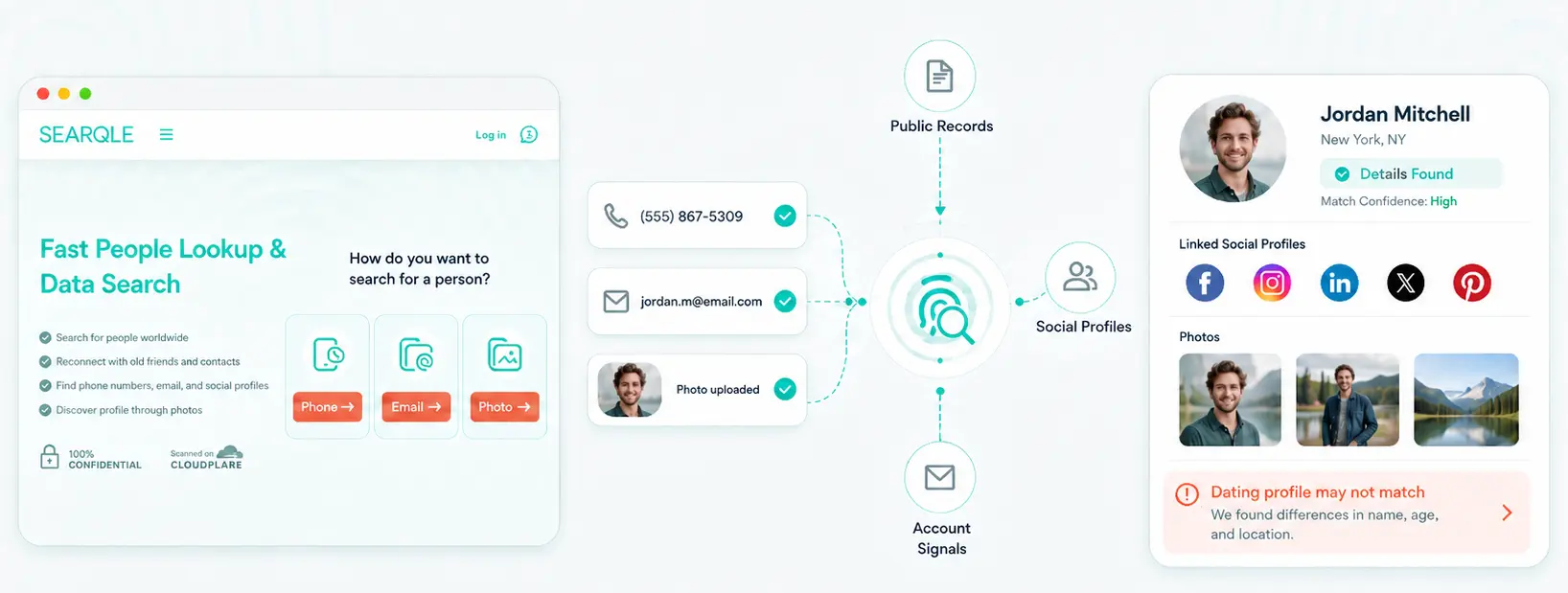
The mechanism is simple: Searqle compares your input against publicly available records and account signals, then organizes the matches into one readable report. You skip the manual account-by-account checking and get one place to confirm who you are really talking to.
Other Ways to Find a Tinder Profile
Reverse lookup is the fastest route, but several supporting methods help when you have different starting information. Each has clear limits.
Reverse Image Search on Their Photos
If you have a screenshot of the profile, a reverse image search shows where else that photo appears online. This is the strongest way to spot catfishing: if the same image turns up under a different name or on a stock site, the profile is likely fake. It needs a photo to start, so it works best alongside, not instead of, a phone or email search.
Search by Username Across Sites
People often reuse the same handle on Tinder, Instagram, and other apps. If you know that username, a username search scans many sites for it at once. The limitation is obvious: you need the username first, which most people checking an unknown match do not have.
Manual Social Media Checks
Some social platforms let you find an account by phone number if the user left that setting enabled. Results are hit or miss because privacy settings frequently block it, and it only covers social media rather than Tinder itself.
Dedicated Tinder Checkers
Tools like Cheaterbuster and CheatEye search Tinder’s own deck by location and age to find whether a profile is active. They can confirm someone is on Tinder, but they typically charge per search and return little identity context beyond the dating profile itself.
Comparing Tinder Search Tools
The available tools differ in which inputs they accept and how much identity context they return. The table compares Searqle with common alternatives on the criteria that matter when you are verifying a real person behind a Tinder profile.
| Feature | Searqle | SocialCatfish | Cheaterbuster | CheatEye |
| Phone number lookup | Yes | Yes | No | No |
| Email lookup | Yes | Yes | No | No |
| Photo / image lookup | Yes | Yes | Limited | Limited |
| Searches beyond Tinder | Yes | Yes | No | No |
| Identity & address records | Yes | Yes | No | No |
| Single consolidated report | Yes | Yes | Limited | Limited |
| Data breach exposure | Yes | Limited | No | No |
Searqle fits this use case because it accepts phone, email, or photo and returns a full identity picture, not just a confirmation that a Tinder account exists. It is the best choice when your goal is to verify who someone actually is before meeting them, rather than only checking whether they swipe. It suits anyone vetting an online match, confirming a suspicious profile, or checking a partner’s online presence, with no investigative experience required.
Is a Tinder Profile Search Legal?
Yes, looking up publicly available information is legal in most regions, because the data comes from public and online sources rather than from breaking into any account. The boundary is how you use it. People search tools are intended for personal safety, identity verification, and reconnecting with people, not for harassment, stalking, or decisions about hiring, housing, or credit, which fall under separate regulations.
Legitimate reasons to run a Tinder profile search include:
- Verifying a match before agreeing to meet in person
- Spotting a catfish using stolen or reused photos
- Confirming an online contact is who they claim to be
- Checking whether a partner has an active dating profile
Treat any report as a starting point for your own judgment, not as proof. Public data can be outdated, so use it as one signal among several.
Start Your Tinder Search
Finding someone on Tinder in 2026 comes down to one principle: the search happens outside the app, by matching a phone number, email, or photo against public data. Reverse lookup is the fastest and most complete method, while image and username searches help fill specific gaps.
If you have a number, an email, or even a single screenshot, running it through Searqle turns a frustrating manual hunt into one search and one report, often in under five minutes. That is the clarity worth having before you trust a profile, or a person, you have only met through a swipe.